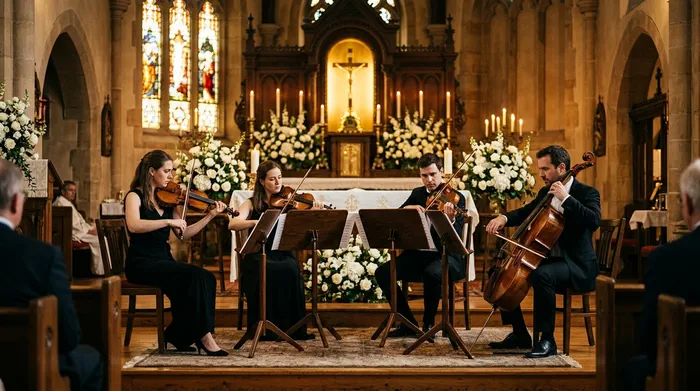
Choosing the music for a Catholic wedding can turn into one of the trickiest parts of the whole planning process. Couples often show up with a list of songs loaded with personal meaning, that ballad that played on their first date, the movie theme that moves them, only to find out that the priest or the parish music director has very clear restrictions on what is allowed and what is not. Understanding the rules for Catholic wedding music before moving forward with your selection saves you from misunderstandings and, above all, guarantees the ceremony flows exactly as planned.
The starting point is understanding that, within Catholic liturgy, music is not decoration, it is a form of prayer. Every piece played in the church or chapel accompanies a specific sacramental moment, and that is why the Church has its own criteria for evaluating it. This guide breaks those criteria down in practical terms, which genres and songs are accepted, which fall into a gray area that depends on the parish, and which are better saved for the reception.
The Constitution on the Sacred Liturgy from the Second Vatican Council states that sacred music must have holiness, goodness of form, and universality. That means before asking whether a song is likable or moving, you need to ask whether it elevates the prayer of those present and respects the solemnity of the sacrament. Music is an integral part of the liturgy, not entertainment hired to make the wait more pleasant.
Every diocese in Mexico can issue its own additional guidelines. A recent example is the document Music for the Celebration of Marriage, Practical Guidelines, published by the Diocese of Cuernavaca, which spells out which styles and moments are appropriate for the wedding Mass. It explicitly reminds readers that music should not function as simple decoration or background, but as a true ministry in service of grace. That is why something that works perfectly at the reception can be completely out of place inside the chapel.
The general rule is that music should be sacred, or at least have a character compatible with the liturgical setting. More options fit into that category than most couples imagine.
This is the safest repertoire, the one no parish tends to question. Pieces like Schubert's Ave Maria, Pachelbel's Canon in D Major, César Franck's Panis Angelicus, or Mozart's Ave Verum Corpus have accompanied wedding ceremonies for centuries and meet every liturgical criterion. These are compositions written with devotional intent, and they work just as well performed by a string quartet, an organ, a soprano, or a piano and violin duo.
For the bride's entrance, Pachelbel's Canon remains the most requested choice for its timeless elegance. The offertory and communion, which are moments of inner reflection, allow for longer, more contemplative pieces, and that is where the Ave Maria, in any of its versions, Schubert, Gounod, Caccini, becomes especially powerful.
The parts that belong to the Mass itself, the Kyrie, the Gloria, the Alleluia, the Sanctus, and the Agnus Dei, are mandatory when the wedding includes a full Mass, and the parish choir usually sings them. The couple can coordinate with the music director on how these parts are arranged, but they can rarely be replaced with freely chosen songs at those specific moments.
In Mexico, the Misa Panamericana accompanied by mariachi is a widely accepted tradition in many dioceses, as long as the mariachi is familiar with the liturgy and its repertoire is oriented toward sacred songs rather than popular tunes. When the mariachi knows the order of the Mass and respects the liturgical silences, it can be just as legitimate an option as a chamber choir.
If the couple is looking for a place where the religious ceremony and the celebration afterward come together seamlessly, it is worth getting to know the private chapel at Gran Malinalco, a venue in the State of Mexico where a natural mountain setting accompanies every moment of the liturgy.
Bach's Air on the G String, the Concierto de Aranjuez, or Ennio Morricone's Gabriel's Oboe are wordless instrumental pieces that many parishes accept because their solemn character suits the setting. The key is that they do not obviously evoke a secular context, an action movie, a trendy song, a sports anthem, and that they are performed live and matched to the pace of the ceremony.
There is a set of songs that are not strictly liturgical but that some churches accept, especially when performed as an instrumental version or with classical arrangements. Before including them in the music program, it is essential to confirm with the priest.
Among the most requested in Mexico are A Thousand Years by Christina Perri, Can't Help Falling in Love, and a handful of film scores such as The Mission or Cinema Paradiso. What makes these pieces acceptable in some churches is their lyrical tone, the absence of explicitly secular lyrics in the instrumental version, and the fact that they never evoke a party or entertainment atmosphere. A string quartet performing A Thousand Years can fit beautifully during the signing of the register or the recessional without breaking the solemnity.
The practical rule, if there are lyrics, the lyrics matter. A romantic pop song with lyrics about human love, without any spiritual dimension, will be harder to justify to the priest than an instrumental version of that same piece. Several priests in Mexico City and the State of Mexico accept instrumental arrangements of contemporary songs for the less liturgically loaded moments, guest seating, the signing, the recessional, but rarely for the offertory or communion.
The restrictions are more specific than most couples expect. Knowing them ahead of time saves you the disappointment of discovering, on rehearsal day, that a key piece in your program is off limits.
Even though they are the most iconic pieces in the Western wedding imagination, Richard Wagner's Bridal March, better known as the Bridal Chorus from the opera Lohengrin, and Felix Mendelssohn's Wedding March, from A Midsummer Night's Dream, do not meet liturgical criteria because they come from theatrical works rather than sacred compositions. Several dioceses in Mexico have explicitly stated that they are not appropriate at any point in the liturgy. Many couples do not find this out until the priest mentions it, so it is worth confirming before building your entire entrance around one of them.
Trending songs, sports team anthems, themes from TV shows or action movies, pop music, or genres like reggaeton and cumbia are out of place within the liturgical celebration. The issue is not that they are bad songs, it is that they were not composed for worship, and their association with entertainment contexts makes them incompatible with the solemnity of the sacrament. These pieces have their perfect place at the reception, where the couple has complete freedom to program exactly what they want.
In most dioceses across Mexico, liturgical guidelines call for live music, since it is considered an active form of the community's participation in prayer. Using recorded tracks or a DJ during the liturgical celebration is generally frowned upon or outright prohibited. If the parish does not have its own choir, the couple will need to hire musicians familiar with that particular church's protocol, who arrive with enough time to set up without interrupting earlier Masses, and who have experience with religious ceremonies.
There is also a rule that surprises many couples, there should be no music during the questioning, the exchange of consent, the giving of the rings and the arras, or the nuptial blessing. These are the most sacred moments of the marriage rite, and the couple's words, their vows, need to be heard clearly, without any musical background. Some experienced musicians play a very soft piece that they gradually fade out as the couple approaches those moments, but many priests prefer complete silence.
| Allowed | Depends on the Parish | Not Allowed |
|---|---|---|
| Ave Maria, Schubert, Gounod | A Thousand Years, instrumental version | Wagner's Wedding March |
| Canon in D Major, Pachelbel | The Mission, Ennio Morricone, instrumental version | Mendelssohn's Wedding March |
| Panis Angelicus, C. Franck | Can't Help Falling in Love, instrumental version | Pop music with secular lyrics |
| Gabriel's Oboe, Morricone | Cinema Paradiso, instrumental version | DJ tracks and recorded music |
| Kyrie, Gloria, Alleluia, Sanctus | Halo by Beyoncé, choral version | Reggaeton, cumbia, and party genres |
| Ave Verum Corpus, Mozart | Film scores in classical arrangements | Music during vows, rings, and arras |
| Misa Panamericana with sacred mariachi | Color Esperanza, with the priest's approval | Sports anthems or TV show themes |
A full wedding Mass calls for somewhere between 7 and 10 musical pieces spread across specific moments. Planning them in order avoids awkward gaps and makes sure every piece lands at the right time.
One of the most common questions among couples planning a wedding in Mexico is whether they can hold the religious ceremony in a chapel located inside the reception venue, without having to move all their guests from one place to another. The answer depends on whether the chapel is consecrated and on the arrangements with the corresponding diocese, but when that option exists, it dramatically simplifies the day's logistics.
Gran Malinalco, located 90 minutes from Mexico City in the State of Mexico, is an example of a venue that solves that need in a single, integrated setting. Its private chapel lets the religious ceremony and the reception take place within the same nine hectare property, surrounded by nature and mountains, with no travel to break up the rhythm of the day. With exclusive use rental and lodging for more than 200 guests, the couple can coordinate the chapel's music program together with the rest of the day, without depending on the schedule and restrictions of a parish shared with other Masses.
Getting married in a space like this also gives you more control over the acoustics and the type of musicians you hire, always in coordination with the officiating priest and the local diocese's guidelines. To learn more about what this venue offers, visit the wedding venue in Mexico section.
Before signing any contract with a choir, string quartet, or soloist, there are three conversations that need to happen first.
In the vast majority of dioceses across Mexico, churches require live music because it is considered a form of active participation in communal prayer. Using recorded tracks, digital players, or DJ services during the liturgical celebration is generally frowned upon or outright prohibited. If the parish does not have its own musicians, the couple needs to hire live performers, choir, quartet, soloist, or mariachi with sacred repertoire, who arrive at least 45 minutes early to set up without interrupting earlier Masses.
In many parishes and dioceses across Mexico, the answer is no. Richard Wagner's Bridal Chorus, along with Felix Mendelssohn's Wedding March, comes from theatrical works rather than sacred compositions, and several dioceses have explicitly stated that it does not meet liturgical criteria. Rather than assume it is allowed, confirm directly with the priest. The most popular, liturgically correct alternative for the bride's entrance is Pachelbel's Canon in D Major.
Yes, as long as the mariachi has liturgical experience and its repertoire is strictly sacred during the Mass. Mexico has a long tradition of celebrating the Misa Panamericana with mariachi, which many dioceses welcome. What is not allowed is for the mariachi to mix in popular songs, rancheras, or trending pieces during the liturgical ceremony. The sacred repertoire, entrance hymns, communion hymns, hymns to the Virgin, should be the only thing heard inside the church or chapel.
This is one of the restrictions that surprises couples the most, during the marital questioning, the exchange of consent, the vows, the giving of the rings and the arras, and the nuptial blessing, there should be no background music, not even instrumental. The couple's words are the central element of the sacrament and need to be heard with complete clarity. Some musicians with liturgical experience play a soft piece and gradually lower it to a minimum as those moments approach, but many priests prefer total silence.
The music at a Catholic wedding is far more than a personal selection of favorite songs, it is part of the rite, and that is why it comes with its own set of rules. Knowing what is allowed, classical sacred music, liturgical chants, mariachi with an appropriate repertoire, what can be negotiated case by case with the priest, instrumental versions of contemporary songs, and what should be saved for the reception, popular music, party genres, theatrical marches, lets you plan a ceremony that blends the spiritual meaning of the moment with the emotion the couple wants to feel.
Couples looking to bring the religious ceremony and the celebration together in one place, with a private chapel, natural surroundings, and complete logistics, can explore what Gran Malinalco offers, just 90 minutes from Mexico City. The team is available to answer any questions and help plan every detail.

With accommodations for over 200 guests, a chapel, an event hall, and a private estate nestled in the natural surroundings of Malinalco.