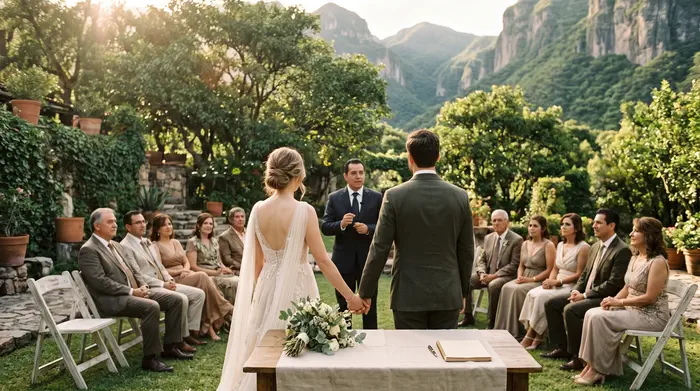
Hiring an on-site civil judge, known in Mexico as a juez a domicilio, lets you hold the civil ceremony in the same garden, hall, or venue where the party will take place, without moving your guests to a Civil Registry office. In Mexico the service carries an official fee that depends on the state: in 2026 it is 3,319 pesos in Mexico City and 3,058 pesos in the State of Mexico, compared to 1,652 and 435 pesos if the marriage takes place at the office. The difference surprises many couples, but it is usually offset by having a single location, a single trip, and a ceremony with family and friends present.
Couples planning a wedding almost always run into the same questions: whether the judge really comes to the location you choose, which documents are required, how far in advance to request the service, and how it fits with the religious ceremony. This guide answers with current official fees, requirements, a step-by-step process, and examples of how to organize the civil marriage at a countryside venue.
An on-site civil judge is the judge or officer of the Civil Registry who travels to the location the couple chooses to perform the civil marriage. According to official information from the Mexican government, Mexican law only recognizes the legal effects of a civil marriage, which is entered into before the Civil Registry authority, called an officer in some states and a judge in others. That is why, even if the ceremony takes place in a garden or an event hall, the certificate that is drawn up has the same legal value as one signed at a registry office.
The cost changes because the fee depends on whether the marriage takes place at the Civil Registry offices or at the location the couple indicates. In practice, the judge arrives with the certificate forms, reads aloud what the law requires, receives the consent of both people, and collects the signatures of the witnesses.
A religious ceremony, whether in a chapel or at an outdoor altar, has no legal validity on its own. Many couples hold both on the same day, one after the other and in the same space, so guests do not have to move between ceremonies.
The Civil Registry provides the judge and the official paperwork, while the wedding venue provides the space. Plan for a sturdy table for the signatures, chairs for the witnesses, a sound system so everyone can hear the reading and the vows, and an area with shade or a roof in case of rain or strong sun. With that taken care of, the judge only needs to arrive at the agreed time.
There is no single national fee, because each state sets its own fees in its own tax legislation. The figures most often consulted by couples planning a wedding near the capital are those for Mexico City and the State of Mexico, summarized below.
| Item | Mexico City 2026 | State of Mexico 2026 |
|---|---|---|
| Marriage at the office | $1,652 MXN | $435 MXN |
| Marriage at your venue | $3,319 MXN | $3,058 MXN |
| Difference for requesting a judge at your venue | $1,667 MXN | $2,623 MXN |
| Marriage outside the territorial jurisdiction | $10,153 MXN | Ask at the Civil Registry office |
Sources: Mexico City Civil Registry fees published by Uno TV and the State of Mexico Civil Registry fee schedule, valid through December 31, 2026, according to adn40. The difference row is our own calculation based on those amounts.
Some publications from the first half of 2026 showed different amounts for the State of Mexico, so confirm the exact figure with the Civil Registry office before paying, especially if your wedding falls close to the new year, when fee schedules are updated.
The fee covers only the official procedure. The Mexico City Civil Registry makes clear that no one may charge additional amounts or ask for cash payments beyond what the Fiscal Code establishes. Aside from the procedure itself, couples should plan for certified copies of the marriage certificate, which are needed in quantity for later paperwork, and for the logistics of the ceremony itself: furniture, sound, and decor for the space where the certificate will be signed.
To put the expense in perspective, the extra cost of the on-site civil judge can be spread across your guests. At a wedding with 120 guests in the State of Mexico, the extra cost compared to the office is 2,623 pesos, about 22 pesos per guest. In Mexico City, with a difference of 1,667 pesos, it would be roughly 14 pesos per person. That is a small amount compared to the cost of transporting 120 people to an office and back to the reception site.
The documents are the same as for marrying at the office, plus a request that the ceremony take place elsewhere. The 2026 Mexico City list is a good reference for what registry offices usually ask for, although each state may add or adjust items.
If either person is a foreign national, Mexico City requires an apostilled or legalized birth certificate and an official Spanish translation when it is in another language. If someone was married before, they must present a divorce certificate, divorce decree, or death certificate, as applicable. These are the documents that delay the process the most, so gather them first.
For couples looking for a place where the civil ceremony, the religious rite, and the reception all happen without any travel, it is worth exploring wedding venues near Mexico City in Malinalco, where exclusive-use rental lets you calmly decide where the judge's table will go.
The space you choose sets the atmosphere of the ceremony and also determines how easily the judge can work. Each option has different advantages.
Gardens are the preferred option for a civil ceremony with an on-site civil judge, but they require attention to timing and weather. In a nature destination like Malinalco, mornings and the late afternoon offer soft light and milder temperatures, while the middle of the day calls for shade or canopies.
A hall or a chapel solves the weather and sound issues and makes the judge's work easier. At venues like Gran Malinalco, which has a private chapel, an event hall, and gardens within 9 hectares (about 22 acres) of exclusive-use rental, the couple can choose one space for the civil signing and another for the religious rite or the reception without sharing the property with other events. To see what these spaces look like, you can check out the chapel and the event hall.
Malinalco is in the State of Mexico, so a civil wedding in the municipality follows the state fee schedule, which in 2026 sets 3,058 pesos for a marriage at your venue. Being about 90 minutes from Mexico City and offering lodging on the property, the couple and the witnesses can arrive the day before, rest, and show up to the ceremony without rushing, a detail that reduces the risk of delays relative to the judge's schedule.
In Mexico City, a wedding performed at your venue costs 3,319 pesos in 2026, compared to 1,652 pesos at the office. In the State of Mexico, the fee schedule valid through December 31, 2026 sets the price at 3,058 pesos for a ceremony at your venue and 435 pesos at the Civil Registry office. Fees are updated every year, so confirm the exact amount with the Civil Registry before paying.
The full process usually takes between 15 and 30 days depending on the state, but the judge's calendar can fill up during wedding season. The best approach is to start two or three months ahead and confirm the date in writing with the Civil Registry office. If either person is a foreigner or has been married before, add extra time for the paperwork.
Yes. A marriage can take place at the Civil Registry offices or at the location the couple indicates, and that location can be a garden, an event hall, or a hacienda. What matters is requesting it from the Civil Registry office that has jurisdiction over the municipality and paying the fee that applies, whether in the State of Mexico, Mexico City, or another state.
No. In Mexico, only the civil marriage has legal effect, so a religious ceremony does not replace the marriage certificate. The most practical approach is to hold both ceremonies on the same day and at the same place, so guests do not have to travel between them. An on-site civil judge makes that continuity possible.
A civil marriage held at a venue stops feeling like a cold formality when it is planned in advance and with the right information. The 2026 fees show that the service costs between 3,058 and 3,319 pesos in central Mexico, a reasonable amount compared to what it means to marry surrounded by the people who matter without moving anyone. The key is to confirm jurisdiction, gather your documents early, and coordinate with the venue on where and when the judge will be.
If you imagine signing your marriage certificate among gardens and mountains, the next step is to see the space and check dates. Gran Malinalco welcomes couples to tour its 9 hectares, the private chapel, and the hall, and you only need to write to us to check availability.

With accommodations for over 200 guests, a chapel, an event hall, and a private estate nestled in the natural surroundings of Malinalco.
Realistic and varied looks for a church wedding, for both women and men