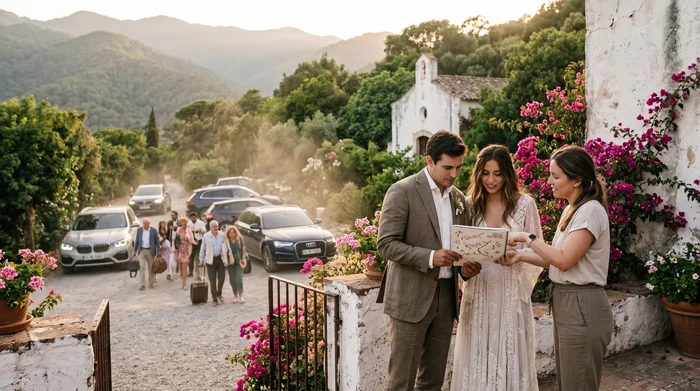
A wedding outside the city changes the logistics from day one. Guests no longer arrive in a few minutes. They depend on highways, departure times, available rooms and vendors who don’t always work in the area. For a couple living in Mexico City, Monterrey or Guadalajara who decides to marry at a nearby destination like Malinalco, the challenge isn’t the venue, it’s making sure every detail arrives complete, at the right place and at the right time.
Most problems repeat from one wedding to the next, and almost all of them can be prevented. They come from four decisions that tend to be made too late: guest transportation, lodging, hiring out-of-town vendors and communicating the itinerary. With a clear checklist, realistic time buffers and a plan B for the weather and transfers, a wedding outside the city becomes as predictable as a local one, with the added benefit of a full weekend in a different setting. Below you’ll find the method, the timeline and the most common mistakes to avoid.
At a local wedding, guests take care of themselves: everyone drives in, goes back home, and the couple only coordinates the event. At a wedding outside the city, the couple also coordinates the travel, the rest and the return trip of dozens of people, on top of the celebration itself. That's why logistics matters as much as the decor or the menu.
The wedding planners interviewed by Chic Magazine agree that a wedding outside the city comes with both advantages and costs. It can be more affordable because not every guest attends, but it means more expense for those who travel and can raise the price of vendors who have to travel too. One of them estimates that about 60 percent of invited guests attend a destination wedding: out of 500 invitations, between 280 and 300 would show up. The figure dates from 2016, so use it only as a reference to size transportation and lodging without overbooking.
Peter de Anda, one of the planners interviewed, recommends checking that connections to the venue are simple: by land, no more than four hours, and by air, a single flight. Hard to reach places complicate guest arrivals and make everything else more expensive. By that standard, a wedding venue near Mexico City like Gran Malinalco, a 90 minute drive from the city, offers nature and mountains without turning the trip into an all day journey.
According to Crónica, the haciendas of the Bajío or central Mexico have no international airport nearby, so the couple needs to tell each out-of-town guest which airport is most convenient and how to get from there to the venue. Malinalco is similar: most guests arrive by road from Mexico City, and those flying in from other states need a clear route connecting the airport to the venue.
The table below summarizes the most frequent failures, where they come from and how to prevent them from the planning stage.
| Problem | Usual cause | How to prevent it |
|---|---|---|
| Guests arriving late to the ceremony | Transfer with no departure time or meeting point | Group transportation with a fixed departure and at least one hour of buffer before the ceremony |
| Not enough rooms | Open reservations with no room block or deadline | Reserve lodging for 60 to 80 percent of the guests who are traveling |
| Vendors who can't find the venue or arrive without equipment | Hiring outside the region without a prior visit | Site visit and a written list of requirements |
| Guests without information | Details scattered across separate messages | Wedding website with map, lodging, transportation and itinerary |
| Bad weather | No covered alternative space | Plan B confirmed in writing with the venue |
| Forgotten or damaged items | Moving the dress, suits and decor at the last minute | Packing list and decor delivery 24 hours in advance |
Group transportation reduces uncertainty because it leaves at a fixed time, takes everyone to the same place and keeps guests from getting lost on unfamiliar roads. Driving your own car works for close family who prefer to move freely, but it requires a clear map and an agreement about who drives back. The most practical approach is to combine both: group transportation for most guests and a list of those arriving on their own. Asking on the RSVP whether there are older guests or families with children lets you assign seats and earlier departures.
A realistic schedule is calculated backward from the ceremony. If the ceremony is at 5:00 PM and the drive from Mexico City takes about 90 minutes, the bus can leave at 1:30 PM, which leaves time to arrive, settle in and rest. The return trip needs the same care: setting at least two departures, one at midnight and a final one at closing time, keeps the party from ending with guests waiting for a ride that doesn't exist.
According to Joy, room blocks usually come with group rates 10 to 25 percent lower than standard ones, and they make transfers easier because most guests stay in one or two places. Their recommendation is to reserve for 60 to 80 percent of those who are traveling, since some will stay with family or friends. When the calculation is based on the actual list of out-of-town guests, and not on the total guest count, the room block stops being too big or too small.
Peter de Anda adds a useful tip: offer options of different quality and price, so each guest can choose according to their budget.
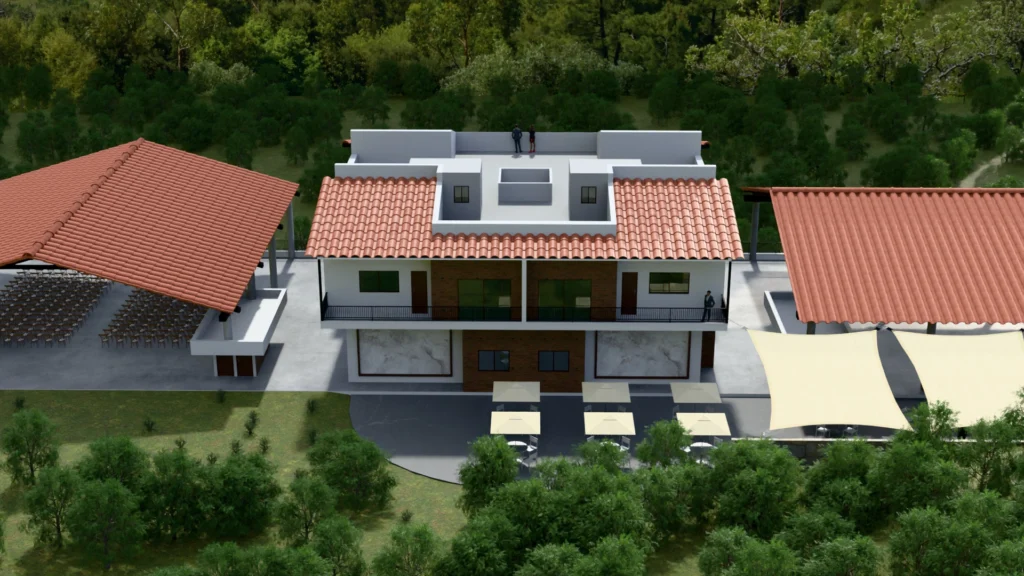
A venue with lodging included solves this point at the root. At Gran Malinalco, a 9 hectare, exclusive use property with lodging for more than 200 guests, attendees sleep right where the celebration takes place, which eliminates late night transfers and one of the main sources of delays the next morning.
If you'd like to see how a full weekend with lodging included is organized, you can check dates and availability on the Gran Malinalco contact page.
One of the planners interviewed by Chic Magazine explains that the couple's preferred vendors may not be in the region, and that hiring them raises costs because of travel expenses. Peter de Anda also warns that at destinations without infrastructure, what you don't bring, you don't have: sometimes everything from kitchens and stages to electrical installations has to be transported. Choosing a venue with a chapel and event hall already in place reduces the amount of equipment that has to travel.
The following step by step guide organizes your to do list by stage.
According to Crónica, a traveling guest needs much more than a date and a place: the full weekend itinerary, lodging options with a group rate, the booking deadline, the expected weather, the dress code and an RSVP that can be updated if their flight changes. Putting everything in a single link avoids repeated private messages.
One of the planners interviewed by Chic Magazine suggests the same principle: a page with a map, hotels, transportation and itinerary, plus activities for those who arrive a few days early, such as a welcome cocktail hour, a traditional callejoneada or a tour of the town.
Having covered alternatives changes the conversation with the venue. At Gran Malinalco, for example, the private chapel and the event hall let you design the celebration with covered options from day one.
The following calculation is illustrative and uses reference figures. It is not a real couple's case. Paula and Emiliano live in Monterrey and choose to marry on Saturday, November 20, 2027 in Malinalco. They send 180 invitations and, using the 60 percent attendance reference, expect about 108 people, so they plan for 110.
Of those guests, 72 travel from other cities, most of them through Mexico City. Using the rule of reserving 60 to 80 percent, they need lodging for 43 to 58 people, and they decide to secure 55 spots with a second hotel option for the rest. For the transfer of the 72 guests, they hire two 40 seat buses from Mexico City, leaving at 1:30 PM for a 5:00 PM ceremony, with two return departures.
With lodging, transportation and schedules defined, the rest of the vendors plan on a solid foundation. To compare what each proposal includes, a wedding package comparison guide helps organize quotes.
Ideally you start 10 to 12 months ahead, because securing the date at the venue, blocking lodging and booking transportation takes longer than for a local wedding. One of the planners interviewed by Chic Magazine recommends sending invitations at least five months before the wedding. A save the date sent seven to six months ahead gives people time to buy flights or request days off.
A wedding planner cited by Chic Magazine estimates that about 60 percent of guests attend, although the number goes up when the venue is easy to reach. This is a 2016 reference, so use it only to size transportation and lodging. RSVPs with a deadline are what set the real number.
Malinalco, in the State of Mexico, is about a 90 minute drive from Mexico City. The most practical option for guests is group transportation arranged by the couple, with a fixed departure point and time. Those driving their own car need a map with the final route and parking confirmed with the venue.
It isn't required, but it's very helpful when the couple lives in another city and can't visit the venue often. One of the planners interviewed by Chic Magazine points out that if the couple won't be physically at the destination, they need someone they trust to research hotels, transportation and vendors. A local coordinator also knows the vendors in the area and reduces travel expenses.
The logistics of a wedding outside the city can't be improvised, but they don't require an endless manual either. It works when the couple decides four things early: how guests arrive, where they sleep, who sets up each service and how everyone finds out the details. Everything else is more enjoyable when the weekend already has a clear route.
Gran Malinalco, in Malinalco, State of Mexico, 90 minutes from Mexico City, brings together on a single 9 hectare property several of the decisions that complicate other weddings: a private chapel, an event hall, exclusive use rental and lodging for more than 200 guests. To learn about available dates and tour the venue, the couple can reach out through the contact page.
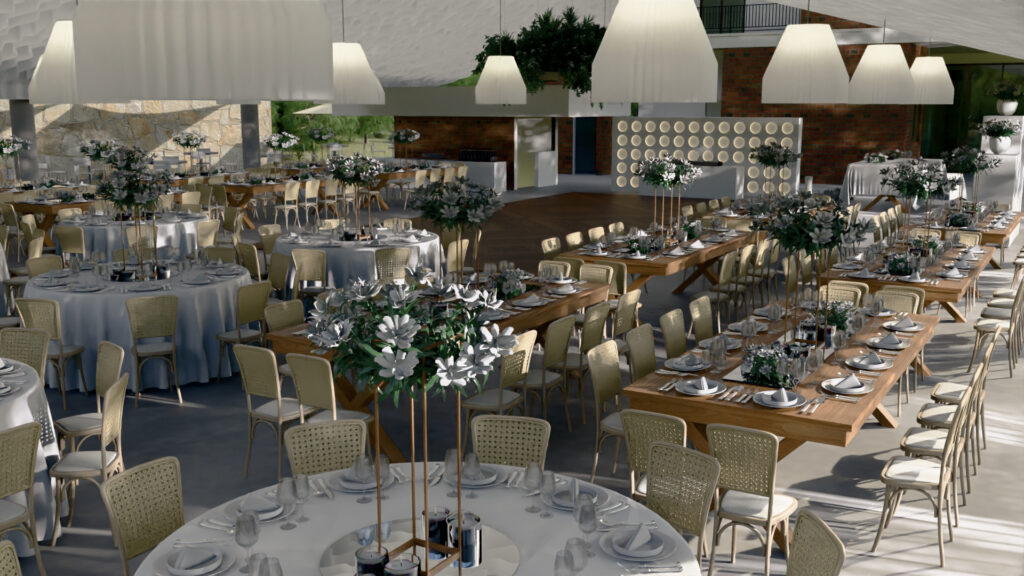
With accommodations for over 200 guests, a chapel, an event hall, and a private estate nestled in the natural surroundings of Malinalco.