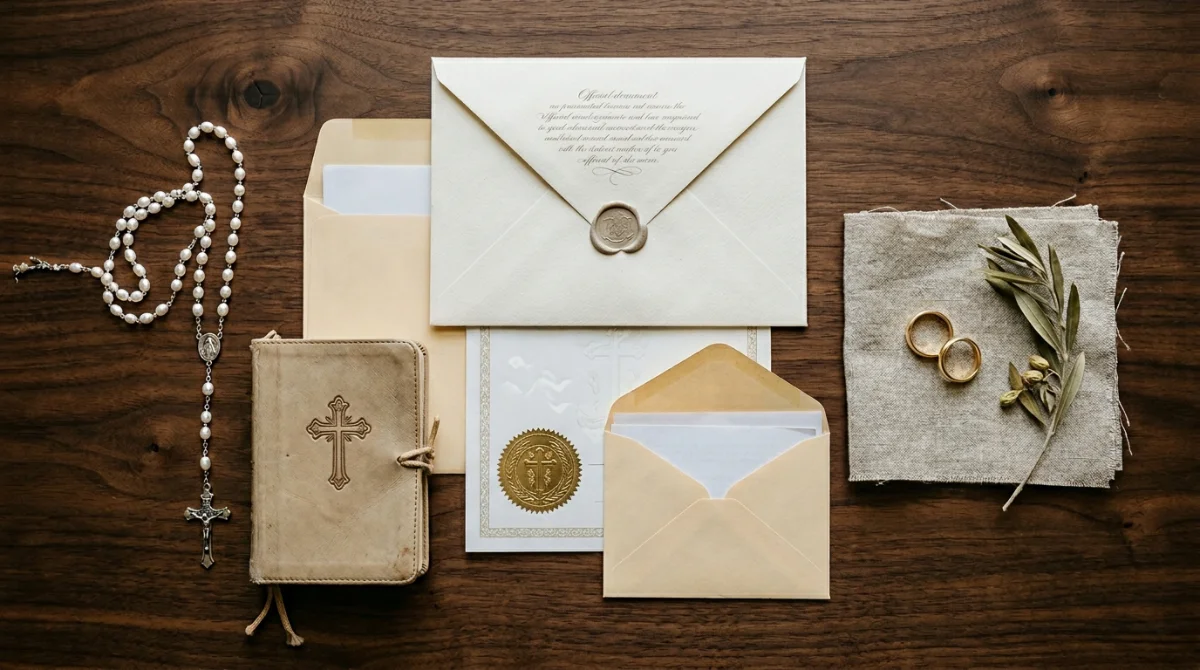
Getting married in the Catholic Church in Mexico is about so much more than signing paperwork — it's the start of a spiritual, sacramental, and administrative process that takes time, planning, and clarity. A lot of couples underestimate the documents required for a Catholic wedding and show up at the parish thinking everything can be wrapped up in a few weeks. The truth is, the process can take anywhere from six months to a full year, and each step depends on the one before it being done.
Mexico has over 97 million Catholics, which is just over 72% of the total population. For most people, a church wedding isn't just paperwork — it's a commitment of faith. But that commitment comes with canonical, pastoral, and civil requirements that, when approached with a clear plan, stop feeling like a burden and start feeling like part of the journey to the altar.
Do you have a date yet? Have you talked to the priest? If the answer to either of those is no, this article is your starting point. Here you'll find the complete list of Catholic wedding documents in Mexico, the right order to tackle everything, and everything you need to know to get to your wedding day without any last-minute scrambling.
Before diving into paperwork, the Church looks at something first: your sacramental status. Baptism is non-negotiable — it's the foundational sacrament of Christian initiation, and without it, a religious marriage simply can't happen. Confirmation is the second key sacrament; the Church typically asks that both partners be confirmed before the wedding.
In some cases, you can start the process without confirmation — the candidate can get confirmed while the wedding paperwork is underway. If you were confirmed but don't have proof, you'll need to work that out directly with your priest.
These are the Catholic wedding documents that most parishes in Mexico require, based on the guidelines of the Archdiocese and the Code of Canon Law:
Each partner needs to bring two adult witnesses who can vouch that the relationship is real, solid, and that both people are getting married of their own free will. All four witnesses will need to show a government-issued ID and will have a brief interview with parish staff.
The godparents need to provide a copy of their own Church marriage certificate. If they're single, they'll need to provide a copy of their baptismal certificate. They must be practicing Catholics.
Pre-marriage counseling isn't just a box to check. These sessions cover things like building a life together, communication, working through conflict, being open to having children, and what marriage really means from a Catholic faith perspective. When you finish, you'll get a certificate that goes into your wedding file.
If you take the pre-marriage course at a different church from where you're getting married, it's completely valid — as long as you provide the certificate with the official stamp and signature from that parish.
This is one of the most common questions. More and more parishes are asking for the civil marriage certificate before proceeding, though this requirement varies by diocese. The main reason is to protect the legal rights of both partners and any future children. If you're planning to have the church ceremony first and the civil ceremony later, check with your priest to find out if that's allowed in your diocese.
Marriage banns are a public announcement at the parish that two people intend to get married. The announcement runs for approximately three weeks. The purpose is to confirm that there are no known obstacles to the marriage. This step happens after you've submitted your file and before the ceremony itself.
If your previous marriage was only a civil ceremony, you can get married in the Church without any special process — you just need the divorce decree. The Church will confirm there was no prior religious marriage. If there was a previous Catholic marriage, the process is different and requires a declaration of nullity (annulment).
If you want to hold your wedding at a parish outside your home area — say, a chapel inside a venue in a Pueblo Mágico — you'll need the original Transfer Letter or Marriage License (Traslado o Licencia Matrimonial), signed and stamped by both your home parish and the corresponding Diocese. Without this document, the ceremony cannot take place.
Wedding dates get booked up fast, and you risk not finding availability on the day you want if you wait too long. Documents like the baptismal certificate have limited validity, so they need to be requested at just the right time — not too early, not too late.
Pulling together all the Catholic wedding documents in Mexico is a process that has a clear logic and order to it. Start at the parish, confirm the specific requirements for your diocese, organize your file step by step, and don't leave anything for the last minute. When the day finally comes, the only thing that will have mattered is being present, looking at each other, and saying yes.
If you're looking for a private chapel inside an exclusive venue to celebrate your religious ceremony surrounded by nature, Gran Malinalco has its own chapel in Malinalco, State of Mexico — available for religious ceremonies in an intimate, private setting, just 90 minutes from Mexico City. The sacred space is already there. You bring the story.
Explore the Chapel
With accommodations for over 200 guests, a chapel, an event hall, and a private estate nestled in the natural surroundings of Malinalco.