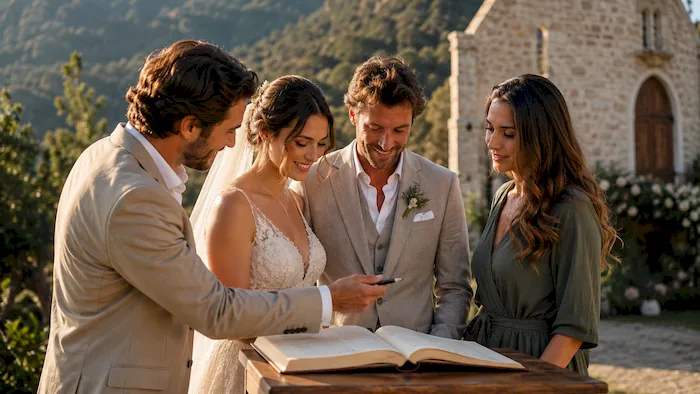
Choosing your civil wedding witnesses can feel like a minor formality, until it is time to decide who makes the cut and who does not. In Mexico, the Civil Registry requires at least two witnesses of legal age with valid official identification, though the exact number and paperwork vary by state and by the local office handling the ceremony. Beyond the legal requirement, the real challenge comes when parents, siblings, and best friends all expect that spot, and the couple has to hand out a limited honor without hurting anyone's feelings.
This guide explains how many witnesses you need, what documents they should bring, how they differ from padrinos, and what criteria actually help you decide, so the choice does not turn into a family conflict before the wedding.
Civil wedding witnesses are the people who sign the marriage certificate and who, under the law, state that they know the couple and that the marriage is happening by the free will of both spouses. This is not a decorative role, their signature carries legal weight and becomes part of the marriage record that the Civil Registry keeps permanently.
That is why, even though it can feel like a small formality, choosing your civil wedding witnesses deserves the same attention as other legal aspects of the wedding, such as the marital property regime or an updated birth certificate. On signing day, witnesses must bring valid official identification and confirm, in front of the judge or Civil Registry officer, that there is no legal impediment to the marriage.
The general rule in most states is two witnesses per spouse, meaning four people total, although some municipalities accept just two witnesses shared between the couple. The exact number depends on the state where you file the paperwork, so it is worth confirming directly with the local Civil Registry office before finalizing your list.
The table below summarizes what some of the states most frequently chosen by couples planning a wedding near Mexico City tend to ask for, including the State of Mexico, home to destinations like Malinalco.
| State | Witnesses required | Main document | Important note |
|---|---|---|---|
| Mexico City | 2, one per spouse (can vary by office) | Valid voter ID, passport, or professional license | Confirmed based on the office you choose |
| State of Mexico | Up to 2 per spouse (4 total) | Official identification, original and copy | Appointments are booked through the state's official Civil Registry system |
| Other states | 2 minimum, some require 2 per spouse | Valid official identification | Varies by municipality and type of ceremony (office or on location) |
Confirming the exact number with the corresponding Civil Registry office avoids last minute surprises, especially when the wedding takes place outside the city where the couple lives.
It is common to confuse witnesses with padrinos, but they serve very different roles. Witnesses have a legal function, they sign the certificate, and their presence is required for the marriage to be officially recorded. Padrinos, on the other hand, play a symbolic and traditional role, most common in religious or symbolic ceremonies, where they take part in rituals such as the arras or the lazo, with no legal requirement involved.
This distinction matters especially when a couple plans a civil wedding followed by a symbolic or religious ceremony the same weekend, an increasingly common format among couples celebrating in destinations like Malinalco, in the State of Mexico, 90 minutes from the capital. In those cases, it is worth deciding early on whether the civil witnesses will also serve as padrinos during the later ceremony, or whether they will be different people.
When the civil ceremony and the celebration happen the same weekend, many couples prefer a venue where both moments, the signing and the party, take place without moving guests from one location to another. The private chapel at Gran Malinalco allows the civil ceremony to connect directly with a symbolic or religious one without ever leaving the property, which simplifies logistics for witnesses and guests alike.
Handing out the role of witness should not depend only on how close a family member is, but on how well that person can represent the couple's commitment. Before deciding, it is worth walking through the following steps.
The requirements are usually simple, but it is worth reviewing them ahead of time so no one shows up on the wedding day missing something. In general, each witness must bring valid official photo identification, a voter ID, passport, or professional license, and some municipalities also ask for a simple copy of that document. It is a good idea for the couple to send this information to their witnesses at least a month in advance, along with the exact arrival time and the location where the signing will take place.
For couples planning their civil ceremony as part of a full wedding weekend, having a venue that handles both the legal process and the celebration simplifies logistics for witnesses, padrinos, and guests. The event hall at Gran Malinalco, with capacity for more than 200 guests and on-site lodging included, allows the signing, the ceremony, and the party to happen without anyone having to travel between different parts of the city.
Most states require two witnesses per spouse, meaning four in total, although some municipalities accept two witnesses shared between the couple. The exact number depends on the state, so it is best to confirm directly with the Civil Registry office you plan to use before the wedding date.
The basic requirements are similar in both places, valid official identification and legal age. The main difference lies in the administrative process, since the State of Mexico books appointments through its own state system, while Mexico City handles them by office, with timing and costs that can vary by municipality.
Yes, in most states parents can serve as civil wedding witnesses, although some local registry offices prefer that witnesses not be direct blood relatives. It is worth confirming this ahead of time, since the rule varies depending on where the marriage takes place.
Witnesses serve a mandatory legal function, they sign the marriage certificate, and their presence is required for the marriage to be officially recorded. Padrinos, by contrast, play a symbolic and traditional role within a religious or symbolic ceremony, with no legal requirement behind that role.
Once you have settled who will sign the certificate, the natural next step is deciding where and how the rest of the celebration will unfold. Many couples use the same weekend to combine the civil ceremony with a symbolic ceremony and the reception, which simplifies logistics for witnesses, padrinos, and guests traveling in from Mexico City or elsewhere.
Gran Malinalco, set 90 minutes from the capital amid mountains and nature, offers exclusive rental of its nine hectares, a private chapel, and lodging for more than 200 guests, making it possible to handle the legal paperwork and the celebration without moving anyone from one location to another.
To check date availability and get your questions answered about combining your civil ceremony with the full celebration, schedule a visit with our team.
Schedule your visit
With accommodations for over 200 guests, a chapel, an event hall, and a private estate nestled in the natural surroundings of Malinalco.