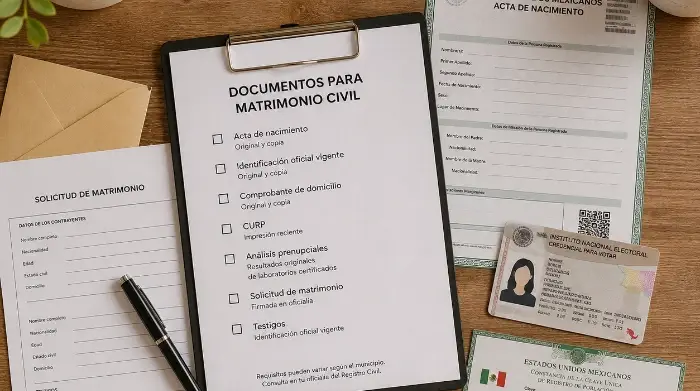
Before the dress, the menu, or the guest list, every couple planning to marry in Mexico faces one unavoidable task: gathering the civil marriage documents required by law. This is the only ceremony that carries legal weight, and without the paperwork in order, no religious or symbolic ceremony, however beautiful, has any legal effect. Many couples find out too late that a birth certificate had expired or a medical exam was no longer valid, forcing them to push back the date they had planned around.
The process varies by state, and sometimes even by municipality, but there is a core set of documents that almost every Civil Registry office in the country asks for. This guide walks through those requirements, explains the differences between Mexico City and the State of Mexico, and lays out a step by step process so the couple can walk into the Civil Registry office with no surprises and no last minute scrambling.
While each state tweaks a few details, there is a set of documents that repeats across nearly every Civil Registry office in the country. Gathering this list ahead of time keeps the process from stalling over a missing or expired paper.
When one partner is not Mexican, the process gains an extra layer: the birth certificate must be apostilled or legalized, translated into Spanish by an authorized translator, and in several states, accompanied by a certificate of no impediment issued in their home country. It is also worth checking passport validity and immigration status before booking an appointment, since some Civil Registry offices ask for proof of legal stay in Mexico. This guide on marrying a foreign partner in Mexico covers the full process for binational couples in detail.
Gran Malinalco sits in the municipality of Ocuilan, State of Mexico, about ninety minutes from Mexico City, so most couples planning their civil wedding there need to file with one of the more than 125 municipal Civil Registry offices in the state, while others prefer to handle the paperwork in their home borough in the capital before traveling to the venue for the celebration.
In the State of Mexico, the process is not centralized: each municipality runs its own Civil Registry, with its own fees and hours depending on the area. Appointments can be booked online through the State of Mexico Marriage Scheduling System, which also shows current fees by municipality. It is worth reserving the date at least 30 days ahead, especially during peak wedding season.
In the capital, marriage registration falls under the Legal Counsel and Legal Services Office, with courts distributed by borough. Couples can check requirements and book an appointment through Mexico City's Civil Registry portal, and unlike other states, a prenuptial course is mandatory here before the ceremony.
| Document or Requirement | State of Mexico | Mexico City |
|---|---|---|
| Birth certificate | Certified copy, generally valid for less than 1 year | Certified copy, no strict expiration date |
| Official ID | Voter ID, passport, or professional license | Voter ID, passport, driver's license, military card, or professional license |
| Witnesses | Two per partner, with ID | Two per partner, with ID |
| Prenuptial course | Not always mandatory | Mandatory for both partners |
| Authority | Corresponding municipal government | Civil Registry courts by borough |
| Approximate cost | Varies by municipality, set in the state Financial Code | Updated annually in Mexico City's Official Gazette |
More and more couples prefer to handle the civil ceremony at the same place where they celebrate, instead of splitting the day between a government office and the reception venue. At Gran Malinalco, a nine hectare venue surrounded by mountains ninety minutes from Mexico City, this is possible because the municipality's Civil Registry allows the judge to travel to the property to officiate the ceremony on site. The couple can sign the certificate in the private chapel or in the gardens, and move straight into the celebration with no travel and no dead time between the legal ceremony and the party.
This complete guide on holding a civil wedding at a venue breaks down exactly what a couple needs to request from the municipal Civil Registry to authorize this arrangement. The combination of exclusive rental, lodging for more than 200 guests, and a natural setting means the legal process feels like part of the celebration rather than a separate errand.
It is best to start two to three months before the chosen date. That window allows time to request a certificate from another state, apostille documents if either partner is a foreign national, and book an appointment at high demand Civil Registry offices, where dates can fill up weeks in advance.
It depends on the state and municipality. Some states have already dropped it from their requirements, while others still require blood work and screening for sexually transmitted infections, valid for 30 to 60 days. The safest move is to confirm directly with the Civil Registry office handling the filing.
Yes, many municipalities allow a Civil Registry official to travel to a venue, garden, or private home to officiate the ceremony. This usually comes with an added fee and needs to be requested 30 to 60 days ahead, so it is worth arranging at the same time the date is booked with the venue.
Not exactly. Civil marriage is the only kind with legal standing anywhere in Mexico, but each state and municipality adjusts details like how long certificates stay valid, the number of witnesses, whether the prenuptial course is mandatory, and the fees involved. It is worth confirming the specific requirements with the Civil Registry office where the couple will marry.
Civil marriage documents in Mexico do not have to become a headache if the couple starts gathering them early and confirms the exact requirements of the municipality where they will marry. Between certificates, IDs, witnesses, and in some cases a prenuptial course, the priority is getting the legal process squared away so the couple can focus on the rest of the celebration. If the goal is to handle the paperwork and the party in the same place, the Gran Malinalco team can help the couple coordinate the municipal Civil Registry around the event date.

With accommodations for over 200 guests, a chapel, an event hall, and a private estate nestled in the natural surroundings of Malinalco.