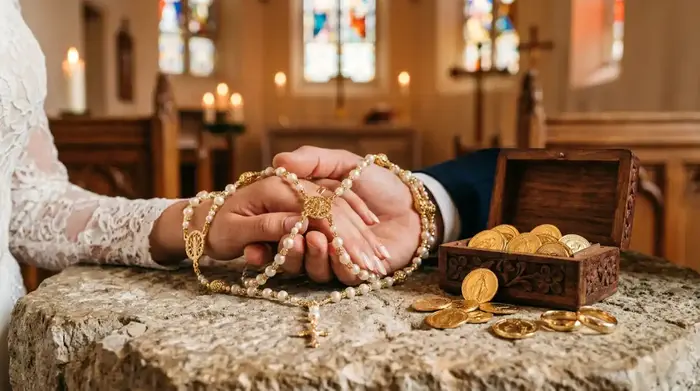
Some moments in a Catholic wedding go far beyond tradition. They are instants loaded with intention, history, and love that, when truly understood, completely transform the experience of getting married in a church. The meaning of the arras, the lazo, and the rings in a Catholic wedding is one of those hidden treasures that many couples live through without fully grasping. And when you do discover it, something shifts: they are no longer just objects or rituals, but living promises you can touch, exchange, and feel deep in your soul.
Have you ever wondered why there are exactly 13 coins? Why the lazo wraps around both of you at the same time? Why the ring goes on that finger and not another? Every detail has a reason, a root, and a purpose. Understanding them turns your ceremony into a conscious, deeply meaningful experience. This article is for couples who want to live their Catholic wedding from the inside out, not just from the outside in.
The hope for a prosperous marriage is represented by 13 coins known as arras, one of the most important traditions in a Catholic wedding ceremony.
The arras must be 13 small coins. They represent the 12 months of the year, plus one extra coin symbolizing the duty to share with those in need. Twelve coins stand for the months of the year, spreading wealth across time, while the thirteenth has traditionally been dedicated to those less fortunate. The practice traces back to Roman law, where arras esponsalicias served as a guarantee between families, a custom the Catholic Church later adopted and gave deeper spiritual meaning.
After the exchange of rings, the priest blesses the arras and the groom takes them in his hands and presents them to the bride. She receives them with open hands, then passes them back to the groom, making a mutual commitment to work toward the couple's financial stability. It is a profound gesture, a quiet agreement to build a life together and care for what they share.
The lazo is one of the most traditional rituals in Catholic wedding ceremonies, representing the unbreakable bond between husband and wife.
The lazo symbolizes the indissoluble union of marriage and has roots going back to antiquity and the Middle Ages. Saint Isidore of Seville described it as a garland of white and purple placed over the shoulders of the couple: white representing the purity of marriage, and purple standing for the blood of future generations.
The lazo can be made of two loops, one looping around the bride and one around the groom, joining them at the center. This creates an infinity symbol, representing the eternal love that binds them. It can also be a single loop, and may include a small plate engraved with the couple's names and wedding date, or more traditionally, a cross similar to a rosary, representing the Catholic faith that will stand between them and remain with them always.
Wedding rings represent the covenant of love and the mutual self-giving between spouses. Their circular shape, with no beginning and no end, stands for the perfect, infinite union of two people.
The tradition of the wedding ring goes all the way back to ancient Egypt, where the circle represented an infinite form, giving shape to the eternal meaning of love. The Greeks later carried on the practice and were the first to place the ring on the fourth finger, since it was believed that finger contained the vena amoris, a vein connected directly to the heart.
Many couples wonder how these three moments fall within the Mass. In the Catholic rite, the lazo is placed after the couple has exchanged rings and received the arras, while they kneel together before the altar.
The lazo is the emotional crown of the union, the final visible seal of everything just promised in words before God and loved ones.
Wedding sponsors are trusted individuals chosen by the couple to participate in the ceremony by bringing the symbolic objects, such as the rings, arras, or lazo, forward to the priest. The main sponsors in a Catholic wedding are:
Choosing these people thoughtfully is part of the intention with which a meaningful wedding is built.
Learning what the arras, the lazo, and the rings mean in a Catholic wedding is not just a fun fact. It is a form of presence. It is a way of telling your partner, before God and everyone you love, that every gesture carries real weight. That you are not there out of habit or tradition, but out of genuine conviction.
A chapel that breathes history and spirituality can make that moment even more powerful. The setting where you say your vows matters just as much as the words you choose.
The arras that are given, the lazo that binds, and the rings that seal the promise are not props in a ceremony. They are the language of committed love, spoken in gestures, blessed by faith, and held in memory forever. When you experience them with awareness, your church wedding becomes something that goes far beyond the day itself.
Can you already picture how you want to live those moments? Make it happen in a space that is worthy of their meaning. At Gran Malinalco, we have an intimate chapel full of spirituality, surrounded by nature, where every ritual comes to life with authenticity.
Discover Our Wedding Venue Near Mexico City →✦ You might also like

With accommodations for over 200 guests, a chapel, an event hall, and a private estate nestled in the natural surroundings of Malinalco.